
Independent analysis of the materials and compounds inside modern tyres
Tyres are complex chemical products
Beneath the tread pattern sits a mixture of natural rubber, synthetic polymers, fillers, plasticisers, stabilisers and antioxidants. Each manufacturer uses its own formulation and even small differences in chemistry can change how a tyre wears, how many particles it releases and how those particles behave in the environment.
Understanding tyre chemistry is essential for improving performance, durability and environmental impact. Our BTAS chemical analysis provides one of the most detailed and comparable datasets available.
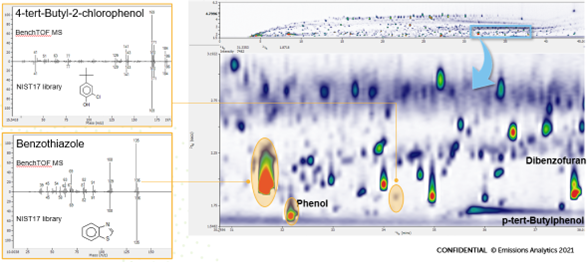
Tyres are a complex mix of components and compounds. To be able to separate and identify all the organic compounds, Emissions Analytics utilises two-dimensional gas chromatography coupled with time-of-flight mass spectrometry to yield a unique and detailed chemical fingerprint for each tyre using a specialised and highly-optimised form of analytical pyrolysis.
What we analyse
Using laboratory techniques and harmonised sampling, we profile the chemical composition of tyres across brands, sizes and categories.
Screening for targeted compounds, for example 6PPD
Testing and evaluation of source component and additives in tyre manufacturing
Full chemical fingerprint of original tyre and tyre wear material
Competitor monitoring and benchmarking
R&D testing of new formulations
Performance and stress testing
Failure analysis
Environmental degradation and leaching testing
Human health and environmental hazard estimation
Read more about our laboratory capabilities.

We measure:
Filler materials, including carbon black and silica
Polymer types and blends
Additives such as antioxidants and plasticisers
Key marker compounds of regulatory interest
Compounds linked to degradation pathways, including 6PPD and 6PPD-quinone
This builds a clear fingerprint of what each tyre is made from and how that chemistry may influence wear behaviour.
Why composition matters
Tyre chemistry affects:
Wear rate and longevity
Particle size and structure
Environmental mobility in air and water
Toxicity potential, depending on the compounds released
Performance characteristics, from grip to rolling resistance
Better understanding of these materials helps manufacturers innovate and gives policymakers evidence for future standards.
How we test
Emissions Analytics utilises two-dimensional gas chromatography coupled with time-of-flight mass spectrometry to yield a unique and detailed chemical fingerprint for each tyre using a specialised and highly optimised form of analytical pyrolysis.
Our laboratory process includes:
Careful sampling of tyre material from controlled locations
Chemical extraction and identification using established analytical techniques
Cross-comparison with BTAS wear and particle data
Consistent classification to ensure results can be compared across tyre models and years
The result is a scientifically robust, independent dataset trusted across industry and academia.
Explore BTAS in more detail
Upcoming conferences

Interested in chemical data or full BTAS access?
Speak with our tyre team to explore subscription options or tailored analysis.